Presentation at UNESCO-UIPE / Africa Engineering Week, Kampala 2025
2025-09-15
|
Kampala
We are proud to announce that, Mr. Balinda Roland Mujungu, a member of our research team, recently p...
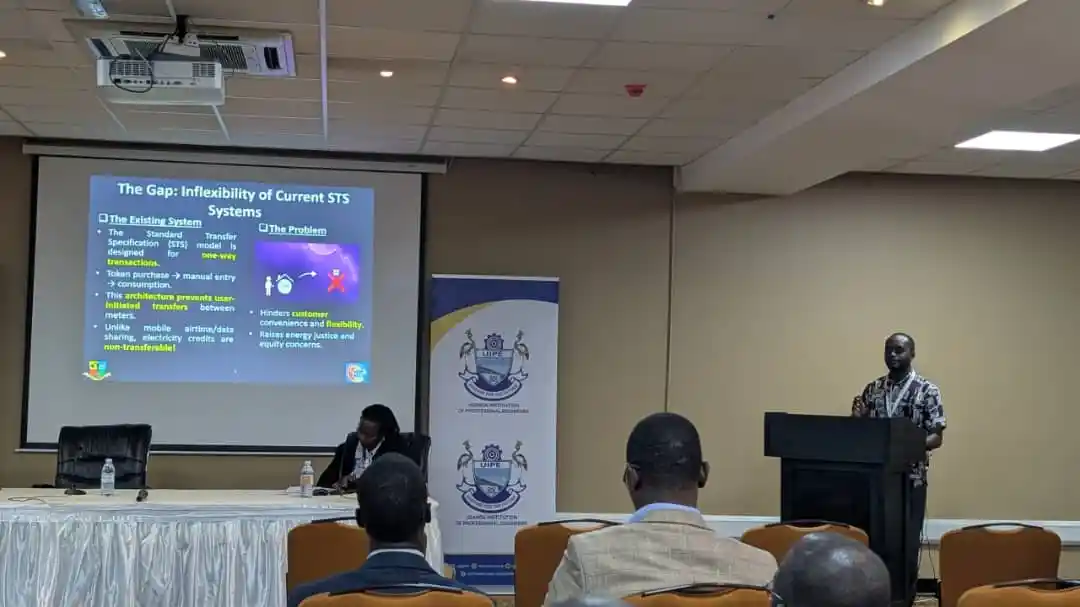
We are proud to announce that, Mr. Balinda Roland Mujungu, a member of our research team, recently presented a research paper at the 11th UNESCO Africa Engineering Week & 9th African Engineering Conference held from 14th to 20th September 2025 at Speke Resort, Munyonyo, Kampala, Uganda.
His presentation was titled: “Peer-to-Peer Energy Sharing System for Smart Electricity Utility Meters”
About the Conference
The UNESCO-UIPE event, also known as Africa Engineering Week and African Engineering Conference, is a flagship gathering of engineers, researchers, industry partners, and policy makers from across Africa and beyond. Its mission is to promote engineering excellence, catalyze innovation, and foster collaborations that advance sustainable infrastructure and technology across the continent.
This year’s theme focused on “Engineering for Sustainable Development in Africa: Addressing Climate Change and Building Resilient Infrastructure.”
About the Research & Impact
In his paper, Mr. Mujungu addresses a notable limitation in Uganda’s electricity metering model. Uganda shifted from postpaid to prepaid metering to enhance revenue security and reduce administration costs. However, under the current system, users cannot directly transfer unused electricity credits between themselves, constraining flexibility.
The work proposes and tests an IoT-enabled peer-to-peer (P2P) energy sharing model to enable direct transfer of energy credits between users. Highlights of the approach include:
Use of ESP32 microcontrollers, a secure token-based vending platform, and bidirectional data exchange between meters.
Experimental results showing meter accuracy within ±5%, reliable credit transfers, and automatic load reconnection.
The system closes a service gap by enabling surplus credit sharing without direct utility intervention, promoting collaborative consumption and greater consumer autonomy.
Potential alignment with several Sustainable Development Goals (SDGs): including SDG 7 (Affordable & Clean Energy), SDG 9 (Industry, Innovation & Infrastructure), SDG 10 (Reduced Inequalities), SDG 12 (Responsible Consumption & Production) and SDG 8 (Decent Work & Economic Growth).
This research not only demonstrates a working prototype but also offers a scalable framework that could be adapted to other sub-Saharan contexts, enhancing utility-customer relationships and promoting decentralized energy models.
Congratulations & What’s Next
We extend our warmest congratulations to Roland for this achievement and for representing our lab at an important continental forum. We look forward to building on this work; refining the prototype, exploring larger deployments, and collaborating with stakeholders (utilities, regulators, communities) to test real-world adoption.
We will soon publish the full paper (or proceedings) and share updates on ongoing experiments and deployment plans. Stay tuned!